Procomex and Siscomex: How Brazil is Modernizing Foreign Trade
September 15, 2026 | Posted by Datamar
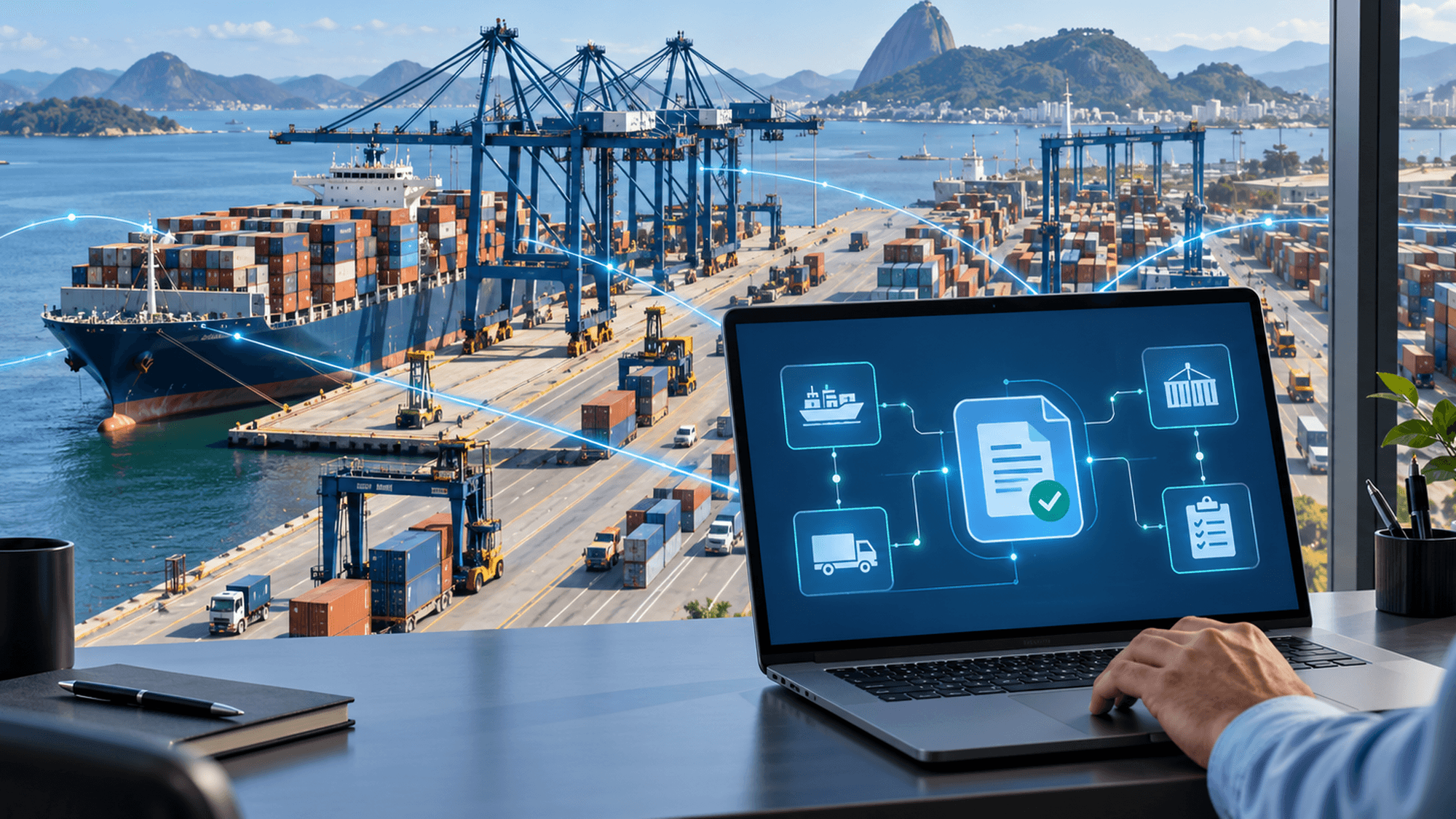
Importing or exporting a product involves much more than arranging transportation between two countries. Companies must inform the government what is being traded, where the cargo is coming from or going to, how much it is worth, and which taxes, licenses and controls apply.
In Brazil, much of this information is registered in Siscomex. The system is undergoing a broad modernization process through the Single Foreign Trade Portal. The goal is to simplify procedures, integrate government agencies and reduce repeated information requirements.
The Procomex Alliance Institute participates in this process by representing the needs of the private sector and helping the government identify difficulties and opportunities for improvement. Datamar, in turn, is an institutional partner of Procomex.
Let’s look separately at the role of each organization and system.
What is Siscomex?
Siscomex stands for Integrated Foreign Trade System. It is the set of official systems used by the Brazilian government to register, monitor and control the country’s imports and exports.
When a company imports or exports, it must provide a series of information to the authorities. Depending on the product, licenses, certificates and authorizations may be required from agencies such as the Federal Revenue Service, Anvisa, the Ministry of Agriculture and Ibama.
Siscomex organizes much of this communication between companies and the government. It is the environment where the information needed for the authorities to review and clear operations is registered.
The system is managed by the federal government, mainly by the Federal Revenue Service and the Secretariat of Foreign Trade.
In simple terms, Siscomex is the public structure used to control the entry and exit of goods in Brazil.
What is the Siscomex Single Portal?
For many years, companies and government agencies used different systems and documents to complete a single operation. In some cases, the same information had to be submitted more than once.
To reduce this bureaucracy, the federal government created the Single Foreign Trade Portal Program in 2014.
The Single Portal is not a company and does not replace Siscomex. It is the main modernization initiative within Siscomex itself.
The idea is to create a single communication window. This means that a company submits information in one central environment, and the different government agencies access the data they need to carry out their controls.
With this, the government aims to:
- reduce repeated information requirements;
- integrate the agencies involved;
- reduce the use of different documents and systems;
- allow some reviews to take place at the same time;
- reduce costs and lead times;
- improve data quality and standardization.
The program is managed by the Federal Revenue Service and the Secretariat of Foreign Trade. Official information and implementation schedules are available on the Siscomex Portal.
What changes for imports?
One of the main stages of this modernization is the New Import Process, known in Brazil as NPI.
Its central element is the Single Import Declaration, known as Duimp. It is gradually replacing the former Import Declaration, known as DI.
The import declaration is the electronic document in which a company provides the government with the main data on the operation. This includes the imported product, the foreign supplier, the value of the goods, the country of origin and the applicable taxes.
Duimp was created to bring together information that was previously spread across different documents and stages. It also allows some procedures to begin before the goods arrive in Brazil.
In addition to Duimp, the new process includes other important components:
- Product Catalog: a registry in which each company enters in advance the goods it usually imports;
- Attributes: information that describes the specific characteristics of each product, complementing its tax classification;
- LPCO: a module used to request Licenses, Permits, Certificates and Other Documents required by government agencies;
- Cargo and Transit Control: tracks cargo movement during the operation;
- Centralized Payment: brings together information on certain taxes, fees and payments.
The migration is gradual. The mandatory date for Duimp depends on the product, transport mode, type of operation and the agencies responsible for controlling the goods.
To help companies, the government provides a simulator for the DI phase-out schedule.
What is Procomex?
The Procomex Alliance Institute is an independent organization that works to modernize and simplify Brazilian foreign trade.
Procomex is not part of the government and does not administer Siscomex. It also does not register imports, clear goods or establish the rules companies must follow.
Its main role is to bring together the two sides involved in the process: the companies that use Siscomex and the government agencies responsible for the system.
In simple terms, Procomex acts as a bridge between the private sector and the government.
How does Procomex support the modernization of Siscomex?
Changes to Siscomex must take into account how operations work in day-to-day practice. A tool may seem efficient from a technical standpoint but create difficulties when used by importers, exporters, customs brokers, terminals and carriers.
Procomex helps identify these situations. To do so, it brings together companies and industry associations from different sectors, listens to system users and organizes the contributions it receives.
Its main activities include:
- mapping import and export processes;
- identifying repetitive procedures and bottlenecks;
- listening to companies and representative associations;
- organizing meetings, consultations and technical debates;
- consolidating questions and suggestions from the private sector;
- forwarding these contributions to the Federal Revenue Service, the Secretariat of Foreign Trade and consenting agencies;
- monitoring the implementation of new functionalities;
- communicating to the government the difficulties companies encounter;
- promoting events to explain the changes and prepare users.
Procomex therefore does not directly change Siscomex. The institute provides technical knowledge and information on the reality of operations to help the government improve processes.
Final decisions on rules, schedules and functionalities remain with the federal government.
A practical example of Procomex’s work
One example is the work related to Product Catalog attributes.
Under the new process, simply providing the tax code for a product is not always enough. Depending on the product, the company must also provide more detailed characteristics, such as composition, model, purpose, material or presentation format.
This information is known as attributes.
Procomex participated in the mapping and definition of these attributes, gathering input from representatives of 43 sectors of the economy and government agencies involved in foreign trade.
This dialogue helped identify which information is truly necessary to describe each type of merchandise. The goal is to improve the quality of the data used in the Product Catalog, in Duimp and in license applications.
More information is available on Procomex’s page about the Single Portal attributes.
What is the relationship between Datamar and Procomex?
Datamar is an institutional partner of Procomex. This partnership brings together two different but complementary areas of expertise.
Procomex works mainly to improve foreign trade processes and communication between companies and the government. Datamar works with data and market intelligence on imports, exports, maritime transport and logistics on the East Coast of South America.
This partnership does not mean that Datamar operates Siscomex or participates in government decisions. Datamar contributes information and market intelligence, while Procomex works on discussing and improving foreign trade processes.
Imports grow as Siscomex modernization advances
The modernization of Siscomex is taking place at a time when Brazilian imports transported in containers are growing.
DataLiner data show that Brazilian imports by container grew 9.2% between January and July 2026 compared with the same period in 2025. In July alone, the increase was 13.3%.
Brazilian imports by container | Jan-Jul 2022 to 2026 | TEU
These figures help show the scale of operations that will be affected by the modernization of customs processes. The larger the trade flow, the greater the need for integrated systems, standardized information and efficient procedures.
DataLiner figures show maritime foreign trade movements. They do not measure Siscomex performance and do not mean that import growth was caused by the Single Portal.
Which products drove imports?
The impact of Siscomex changes varies depending on the merchandise. Each product may have its own tax classification, attributes and administrative requirements.
Between January and July 2026, vehicles and auto parts led the growth in Brazilian containerized imports, up 41.4% from the same period in 2025.
Plastic imports grew 8.3%, while the category comprising reactors, boilers and machinery rose 3.3%.
Main product categories imported by Brazil via container | Jan-Jul 2026 | TEU
The diversity of these goods shows why correctly filling out the Product Catalog and attributes is so important. Incomplete or incorrect information can lead to questions from government agencies, delay cargo clearance and increase operating costs.
China increases its share of Brazilian imports
The origin of goods also shows the variety of operations processed by Brazil’s foreign trade systems.
In the first seven months of 2026, Brazilian containerized imports from China grew 21.6%. Volumes from India increased 4.8%, while imports from the United States fell 32.3%.
Each operation may involve different suppliers, commercial documents, currencies, products and requirements. This is why the quality and standardization of information are essential to the functioning of the new process.
What do companies need to do?
The transition to the Single Portal is not just a system change. It may require companies to review their internal procedures.
Key precautions include:
- monitoring the Duimp implementation schedule;
- reviewing the Product Catalog;
- checking the quality of descriptions and attributes;
- identifying the licenses required for each product;
- adapting internal systems;
- training teams;
- defining responsibilities across tax, legal, logistics, commercial and technology departments.
The sooner a company reviews its data and processes, the lower the risk of facing problems during the migration.
Modernization and market intelligence
The Siscomex Single Portal, Procomex and Datamar play different roles.
The government administers Siscomex and decides how processes will be carried out. Procomex listens to the private sector and brings suggestions to the government to improve those processes. Datamar provides information on import and export flows that helps companies understand the market and make decisions.
While the Single Portal organizes communication between private operators and government agencies, DataLiner allows users to analyze moved volumes, goods, participating companies, ports, shipping routes and countries of origin and destination.
Simpler processes and reliable data are complementary elements. Together, they help companies plan their operations, reduce risks and compete more effectively in foreign trade.