From Data to Strategy: How the Shipping Industry Will Use Emissions Intelligence
August 6, 2026 | Posted by Datamar
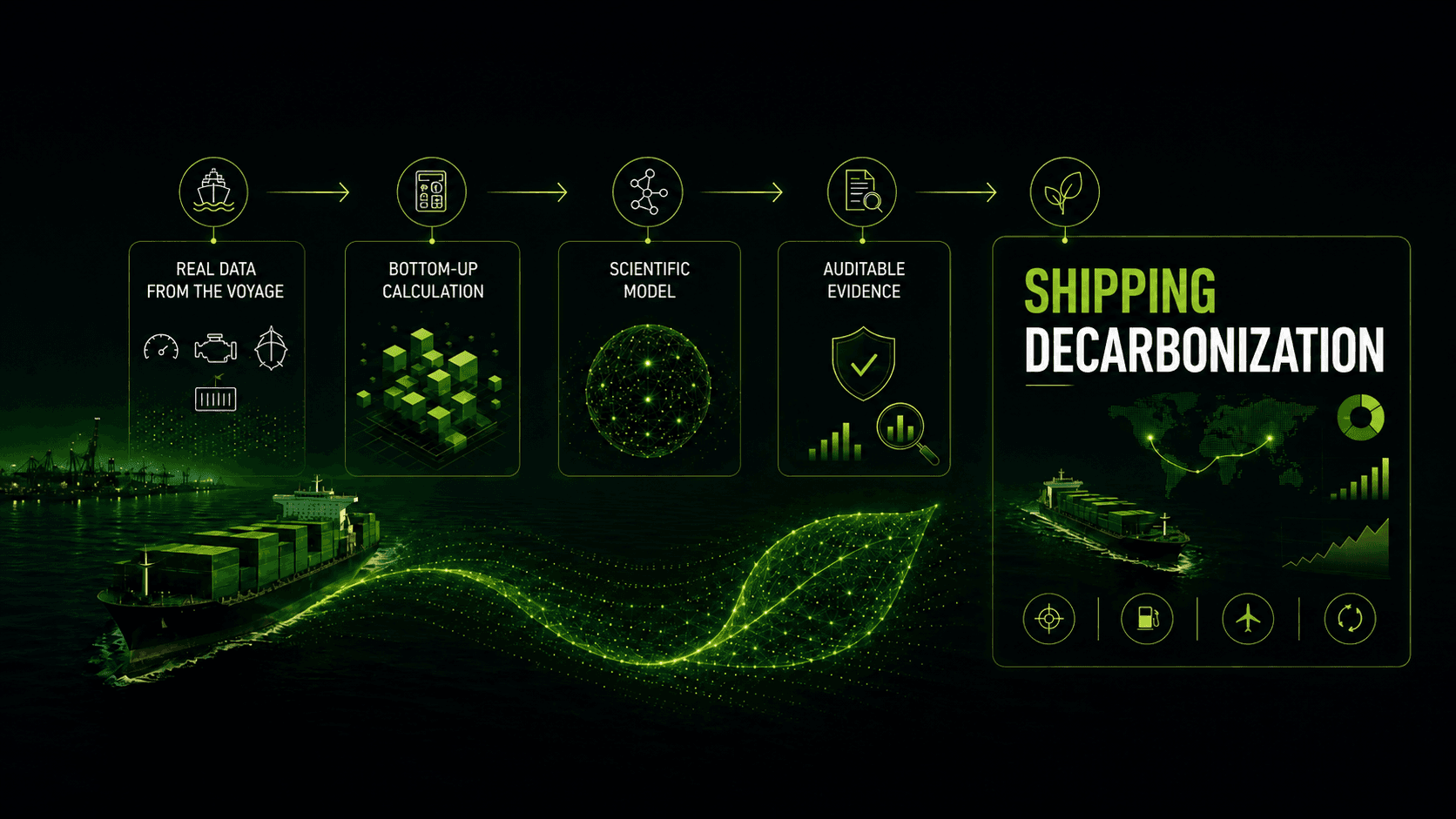
For many years, maritime emissions data was used primarily to prepare inventories, produce sustainability reports, and comply with regulatory requirements. As decarbonization advances, however, this information is beginning to take on a more strategic role.
It is in this context that DatamarLab is developing initiatives to explore how real operational data, technology, and scientific methodologies can enhance maritime emissions intelligence. The goal is to help this information move beyond simply recording past performance and gradually begin supporting operational and commercial decision-making.
In the future, emissions intelligence could help shipping lines, port terminals, freight forwarders, exporters, and importers compare routes, identify inefficiencies, assess suppliers, and plan investments.
This transformation will depend on one essential factor: the ability to produce sufficiently detailed, comparable, and traceable data.
A consolidated figure can show how much carbon was emitted. To support a decision, however, companies need to understand why that result occurred, which operational factors influenced it, and how alternative scenarios might perform.
What Is Maritime Emissions Intelligence?
Emissions intelligence is the organized and contextualized use of carbon data to understand operations, compare scenarios, and support decision-making.
This means going beyond applying an average emissions factor to cargo volume or distance traveled. A more detailed analysis may consider such as:
- vessel type and size;
- sailing speed;
- engine technology;
- fuel used;
- vessel draft;
- vessel capacity and utilization;
- cargo volume and type;
- presence of refrigerated containers;
- route and distance traveled;
- port calls and transshipments;
- waiting time at ports;
- port operating conditions.
When these variables are analyzed together, emissions data no longer merely records past performance. It begins to explain the carbon profile of a voyage.
From Reporting to Decision-Making
The shipping industry’s use of emissions data can be understood in three stages.
Emissions as a Compliance Requirement
In the first stage, data is used for emissions inventories, environmental reports, corporate targets, and regulatory compliance.
The main question is:
How much was emitted?
This information is essential for establishing a baseline and monitoring emissions over time. However, an aggregate result does not always explain which operating conditions contributed to the final figure.
Emissions as an Operational Indicator
The second stage begins when emissions are linked to the actual conditions of a voyage or operation.
The question becomes:
Which factors influenced this result?
The analysis may reveal the impact of speed, waiting time, fuel, vessel utilization, or cargo refrigeration requirements.
As a result, the data can help identify inefficiencies and support comparisons between similar operations.
Emissions as a Strategic Variable
In the third stage, carbon performance becomes part of commercial and strategic decision-making.
The question then becomes:
How can this information improve a future decision?
In this scenario, emissions do not replace traditional criteria such as price, transit time, capacity, reliability, and service quality. Instead, they add a new dimension to the analysis.
Carbon performance could, for example, be considered when selecting a route, hiring a logistics provider, planning a fleet, or assessing a port infrastructure project.
How Shipping Lines Could Use Emissions Data
For ocean carriers, emissions intelligence could support analyses by vessel, service, leg, or voyage.
Shipping lines could link emissions results to factors such as speed, fuel consumption, capacity utilization, cargo profile, and port turnaround times.
Potential applications include:
- comparing the performance of different vessels;
- evaluating speed scenarios;
- identifying legs with higher fuel consumption;
- analyzing fuels and propulsion technologies;
- planning fleet renewal or retrofits;
- responding to regulatory and commercial requirements;
- developing lower-emission shipping services.
- This capability will become increasingly important as carbon-related costs rise and companies need to justify investments in new technologies.
How Port Terminals Could Use Emissions Intelligence
At port terminals, emissions data could be linked to equipment use, cargo handling, waiting times, and vessel turnaround.
Emissions intelligence could help assess:
- equipment electrification;
- cargo-handling efficiency;
- reductions in operating time;
- onshore power availability;
- infrastructure for alternative fuels;
- the environmental impacts of expansion projects.
The data could also show how terminal operations affect the performance of the entire logistics chain, rather than focusing only on emissions generated within the port area.
New Possibilities for Freight Forwarders
Freight forwarders usually present alternatives based on price, transit time, frequency, capacity, and reliability. In the future, carbon performance could be incorporated into these comparisons.
A freight forwarder could show a customer that one option is faster while another has a lower estimated emissions profile.
However, these comparisons will need to be based on equivalent criteria. It will not be enough to present figures produced using different methodologies as if they were directly comparable.
The reliability of the information could become a competitive advantage for forwarders that can explain:
- which data was used;
- which stages of the operation were included;
- how the estimate was calculated;
- which limitations apply to the result.
Exporters and Importers Will Gain a More Detailed View of Their Supply Chains
Cargo owners are facing growing pressure to understand the emissions generated throughout their supply chains.
More granular data could help them analyze the logistics component of their emissions, assess transport providers, and respond to requests from customers, investors, and business partners.
Potential applications include:
- comparing transport alternatives;
- assessing routes and suppliers;
- identifying the most carbon-intensive stages;
- meeting customers’ environmental targets;
- supporting indirect emissions inventories;
- including environmental criteria in tenders and contracts.
For exporters of meat, fruit, and other refrigerated products, for example, the analysis could consider not only distance but also the energy consumed by refrigerated containers during the voyage.
The Shortest Route Will Not Always Have the Lowest Emissions
When comparing two logistics alternatives, the shortest route may automatically appear to be the lowest-emission option. In practice, the outcome depends on several other variables.
A shorter route may use a less efficient vessel, operate with low utilization, or involve long waiting periods. Another option may cover a greater distance but use a more efficient ship, achieve better capacity utilization, and spend less time at ports.
Transshipments, inland legs, speed, fuel, and cargo type may also affect the result.
A meaningful comparison therefore requires a methodology capable of reconstructing each scenario and explaining how the estimate was produced.
Traceability Will Be Essential
To influence commercial decisions, an emissions result must be more than a number displayed on a dashboard.
Users will need to understand:
- the source of the data;
- the period analyzed;
- the logistics stages included;
- the assumptions adopted;
- the calculation methodology;
- the level of uncertainty;
- the limitations of the comparison.
Traceability does not mean that estimates will be free of uncertainty. It means that the path from the original data to the final result can be understood, verified, and, whenever possible, reproduced.
This transparency will be especially important when emissions information affects contracts, investments, environmental targets, or carbon-related mechanisms.
The Challenge of Turning Operational Data into Intelligence
Access to large volumes of data does not automatically produce intelligence.
Information must be organized, connected to its operational context, and processed using consistent methodologies. The industry will also need criteria for comparing routes, vessels, cargoes, and operating periods.
The challenge is to combine granularity, coverage, and reliability without creating a false sense of precision.
A highly detailed result may appear conclusive, but it will still depend on the quality of the input data and the assumptions used by the model. Calibration, scientific validation, and documentation will therefore be essential.
DatamarLab is Testing a Bottom-Up Methodology
This is the context in which DatamarLab is developing its work. The initiative was created to connect maritime data, technology, science, and decision-making.
Its first Proof of Concept is investigating a bottom-up methodology for estimating emissions based on the operating conditions of an actual voyage.
Initially applied to the container vessel EVER FAME, the model considers information such as bills of lading, vessel drafts, port-call times, speed, and vessel characteristics. Calculations are performed by voyage leg and component, including the main engine, auxiliary engines, boiler, and refrigerated containers.
The preliminary analysis demonstrated, among other findings, the importance of the cargo profile. During short cabotage legs operated at low speeds, the consumption attributed to refrigerated containers exceeded that of the main engine.
This result illustrates why distance and nominal capacity alone are not enough to explain the emissions generated by a maritime operation.
The methodology is being expanded to reconstruct each container’s complete journey, including multiple legs and transshipments. The model is also undergoing calibration, with a target mean absolute percentage error of less than 15%.
DatamarLab also has a partnership with USP RCGI focused on developing more transparent and traceable methodologies.
The initiative does not currently offer all the strategic applications discussed in this article. Its purpose is to investigate and develop part of the methodological foundation needed to make these applications possible.
The Future of Maritime Emissions Intelligence
The transformation of carbon data into a strategic variable will happen gradually.
First, the industry will need to improve the quality and coverage of its information. It will then need to advance model calibration, methodological transparency, and the comparison of results produced under equivalent conditions.
As this infrastructure matures, emissions intelligence could support decisions involving routes, fleets, terminals, suppliers, contracts, and investments.
The main advance will not simply be calculating how much the shipping industry emitted. It will be understanding what produced that result and using this knowledge to evaluate future choices.
DatamarLab is working to contribute to this development by creating methodologies that connect real operational data, scientific knowledge, and the needs of different participants across the maritime supply chain.
Discover DatamarLab’s initiatives and follow the development of new methodologies designed to transform maritime data into actionable intelligence: https://www.datamar.com/en/datamar-la